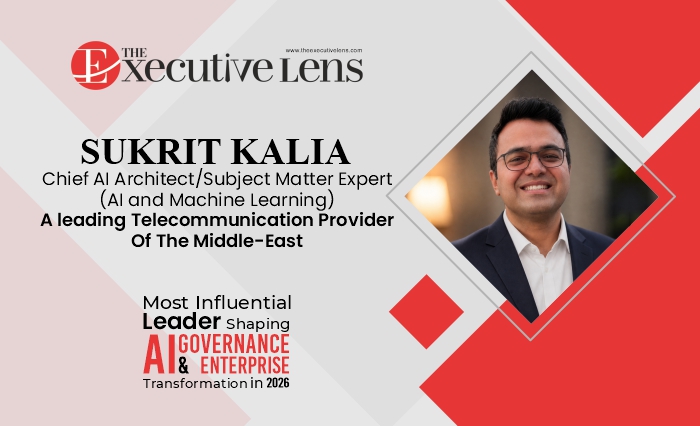
Today, there is no doubt that AI has become the universal truth, and as more and more organizations and leaders unlock its true potential, they are all set to leverage it to accomplish desirable outcomes. With close to two decades of extensive experience driving enterprise transformation across Artificial Intelligence, Cloud, and Digital Architecture, and a Global Recognition Award Winner 2026 in AI Governance and Agentic Architecture, Sukrit Kalia, the new generation AI-adept leader, is focused on advancing next-generation AI systems, governance models, and responsible AI frameworks for enterprise adoption. Spearheading as the Chief AI Architect/Subject Matter Expert(AI and Machine Learning) at a leading Telecommunication Provider Of The Middle-East, Sukrit’s journey in achieving his AI dreams started out of utter curiosity.
As a thought leader in the telecom and enterprise space, Sukrit aims to bring a significant change by shaping the future of Responsible AI, Agentic Systems, and Autonomous Enterprise Architectures and helping organizations transition from experimentation to production-grade AI at scale.
Moving Upwards and Upfront with AI
Sukrit’s journey into AI started less as a career decision and more as curiosity about how decisions are made at scale. Curiosity and sheer passion become foundational pillars of his AI-inspired path. Early in his career, while working with data across different industries, he noticed a recurring pattern: organizations had access to vast amounts of information but very little clarity about how to translate it into meaningful, reliable decisions. Sukrit identified that gap and was fascinated by it. What truly shaped his path was not just building models, but seeing their real-world consequences. He has been in rooms where AI-driven decisions impacted customers, operations, and revenue; that responsibility changes how he thinks. It pushed him to go beyond just “can we build it?” to “should we build it, and how do we control it?
Working with organizations like McKinsey & Company and Siemens, and now leading AI transformation in telecom, Sukrit has had the opportunity to see AI evolve from experimentation to enterprise backbone. Telecom, especially, reinforced the importance of trust—because when AI operates at that scale, even small decisions can have large consequences. That journey shaped his approach: He doesn’t see AI as just a technology layer, but as a system that needs governance, accountability, and human alignment. Today, he focuses as much on designing control mechanisms and governance frameworks as he does on building intelligent systems—because sustainable AI is not just about intelligence, it’s about responsibility.
Apart from winning the global recognition award 2026, Sukrit, recently, was recognised as a 40 Under 40 leader by The Spotlight Magazine for his outstanding work in AI. Right up his alley, he successfully published a great deal of insightful work on AI. Starting from his article (Testing autonomy: Why agentic AI is rapidly rewriting banking QA) got featured in QA Financial and also published a telecom-first whitepaper on Agentic AI Governance in TM Forum, defining a structured framework to enable safe, accountable, and scalable autonomous AI systems across enterprise environments. Alongside, he authored a thought leadership whitepaper on Generative AI in telecom, defining scalable approaches to customer hyper-personalization and shaping industry perspectives on AI-led customer experience transformation. These feats are remarkable as he continues to shine bright in the AI world.
Achieving Much Success in Governance-First AI Project
A project that stands out for Sukrit was architecting an enterprise AI governance and control framework for a telecom organization transitioning toward agentic AI systems. The challenge was not just deploying AI models, but managing autonomy at scale. As Sukrit and his team introduced agent-based workflows capable of making decisions and triggering actions across systems, they identified critical risks like lack of traceability, uncontrolled tool execution, and ambiguous accountability. To address this, they designed a multi-layered governance architecture that included:
Agent action boundaries and policy enforcement layers2.
Human-in-the-loop (HITL) mechanisms for high-risk decisions3.
AI Control Tower for real-time observability and auditability4.
Telemetry and tracing for agent decision flows5.
Risk classification and dynamic access controls
What made this project particularly meaningful was its impact beyond technology—it fundamentally changed how teams approached AI design. Governance was no longer a post-deployment check; it became an architectural primitive. The success of this initiative reinforced a key principle Sukrit carries forward: as AI systems evolve toward autonomy, governance must evolve from static controls to dynamic, system-level orchestration.
Transparency and Trust: Sukrit’s Leadership Principles
One moment that significantly shaped Sukrit’s professional decisions came from a personal realization about trust. Early in his career, he saw how decisions, especially those driven by data, could feel opaque to the people affected by them. Outside of work, he experienced this firsthand when a service he relied on made a decision that impacted him, but offered no clarity on how or why it happened. Later, while leading enterprise AI initiatives, he found himself in a similar position designing systems that could influence outcomes at scale. It made him pause and rethink the approach. Instead of focusing purely on performance, he pushed for greater transparency, traceability, and human oversight in the systems they were building.
That shift led to embedding governance as a core design principle, ensuring decisions made by AI systems could be explained, audited, and, when needed, challenged. It was a reminder that technology doesn’t exist in isolation. Personal experiences shape how one defines responsibility, and in Sukrit’s case, they fundamentally influenced how he approaches building and governing AI systems.
The Ultimate Takeaway
A key lesson from Sukrit’s personal journey has been the importance of balance between execution and reflection, and he has integrated that directly into his leadership approach. Earlier in his career, he prioritized speed and delivery. However, over time, he realized that sustainable outcomes require structured thinking, alignment, and continuous feedback.
In practice, this has translated into how he leads teams, emphasising:
Clarity in goals and decision-making
Open feedback loops and iterative improvement
Creating space for teams to step back, reassess, and refine direction
For example, during a complex AI transformation program, he introduced structured checkpoints not just for progress tracking, but for reflection, ensuring teams could recalibrate based on learnings. This approach improved both execution quality and team engagement.
A Strategic Approach to AI Execution
Sukrit’s personal aspirations revolve particularly around building scalable, responsible, and high-impact systems with a direct influence on how he defines and executes professional goals. Rather than focusing solely on output metrics, he prioritizes outcome-driven and system- level objectives. This includes embedding governance, scalability, and long-term sustainability into goal setting, especially in the context of enterprise AI. It also shapes execution. He emphasizes structured planning, measurable impact, and iterative improvement, ensuring that goals are not just achieved but operationalized effectively across teams and systems. Additionally, a strong focus on continuous learning drives him to align goals with emerging areas such as agentic AI and governance frameworks, ensuring that both personal growth and organizational impact evolve together.
Impact: The Source of Absolute Motivation
What motivates Sukrit to overcome challenges is a strong sense of responsibility toward impact. Whether in his career or personal life, he has always been driven by the idea that the work they do should create meaningful, lasting value.
In Sukrit’s professional journey, especially while leading large-scale AI initiatives, challenges are inevitable, technology evolves rapidly, and the stakes are often high. What keeps him going is the opportunity to solve complex problems that matter, and to do so in a way that is responsible, scalable, and aligned with long-term outcomes. At a personal level, he is motivated by growth and the belief that every challenge is an opportunity to refine how he thinks, decides, and leads. Over time, he has learned to view obstacles not as setbacks, but as signals to adapt, rethink, and improve.
Ultimately, it’s a combination of purpose and perspective—staying focused on the bigger picture while continuously evolving that drives Sukrit to move forward, even in the face of uncertainty.
Acing the Balance Game
Working in high-pressure environments, Sukrit doesn’t treat personal growth and professional responsibility as separate; rather, they have to evolve together. Early in his career, he focused heavily on execution. But as he moved into leading enterprise AI initiatives, he realized that staying relevant requires continuous, intentional growth. Today, he aligns his learning with the challenges he is solving, whether it’s advancing in AI governance, agentic systems, or enterprise architecture, so development happens in the flow of real impact.
Sukrit also focuses on leverage. At a leadership level, it’s not about doing more, but about making better decisions, prioritizing what truly matters, and building systems that scale beyond individual effort. Equally important is reflection, stepping back to reassess direction and refine thinking in a fast-moving space.
For Sukrit, balance isn’t about time; it’s about compounding growth and impact over time. Ultimately, he sees well-being and personal and professional balance as a performance multiplier. Without it, consistency suffers. With it, one can operate at a high level over the long term.
Anchored in Ethical Values
At the core, the values that guide his work are responsibility, integrity, and continuous growth, and they don’t change when stepping outside the office. He firmly adds, “I believe the strongest leadership comes when there’s no disconnect between who you are professionally and who you are personally.”
In Sukrit’s professional life, especially while working on AI systems that operate at scale, responsibility means being conscious of impact, understanding that the decisions one designs into systems can affect people in real ways. Integrity is about doing what’s right, even when it’s not the easiest path, whether that’s pushing for stronger governance or questioning assumptions. And growth is a constant, staying curious, learning, and evolving in a fast- moving field.
What’s important to Sukrit is that these values are consistent in his personal life as well. Responsibility translates into being present and accountable in his relationships. Integrity becomes honesty and authenticity in how he engages with people. And growth shows up as a commitment to learning beyond work, whether through reading, reflection, or new experiences. For him, alignment matters.
Pillars of Influence
Sukrit’s professional and personal development has been shaped by a combination of high-performance environments, complex problem domains, and continuous exposure to evolving technology landscapes.
Working at leading organizations like McKinsey & Company instilled a strong foundation in structured problem-solving and strategic thinking, while experience at Siemens and in telecom transformation exposed him to the challenges of scaling systems in real-world, high-stakes environments. Beyond organizations, the rapid evolution of AI itself has been a major influence. It has required constant learning, adaptation, and a shift from model-centric thinking to system-level architecture and governance.
On the personal side, Sukrit has been influenced by experiences that emphasized resilience and long-term thinking, understanding that meaningful progress often comes from navigating complexity rather than avoiding it.
Unleash the Power of Acting in Real-time Action
One of Sukrit’s personal hobbies is acting, and interestingly, it has had a meaningful impact on how he approaches challenges at work. Acting teaches one to step into different perspectives to understand intent, emotion, and context beyond what’s immediately visible. He remembers working on a complex AI initiative where there was a disconnect between technical teams and business stakeholders. The challenge wasn’t just technical; it was about alignment and communication.
Drawing from his experience in acting, he approached the situation differently. Instead of focusing purely on the solution, he tried to “step into the roles” of different stakeholders, understanding their concerns, expectations, and even unspoken hesitations. It helped him reframe the conversation, simplify complex ideas, and communicate in a way that resonated with each audience.
That shift made a significant difference. Alignment improved, decisions became clearer, and the project moved forward more effectively. It reinforced something he strongly believes: skills like empathy, storytelling, and perspective often developed outside of work can be just as critical as technical expertise in solving complex problems.
Defining Success
Sukrit fondly states, “To me, success is about creating meaningful impact while continuously evolving as a person. In my career, I measure success not just by outcomes, but by the quality and sustainability of those outcomes, whether the systems we build are trusted, scalable, and aligned with long-term goals. It’s also reflected in the people and teams I work with, how they grow, take ownership, and operate with clarity and confidence.
On a personal level, success is more grounded. It’s about balance, integrity, and growth being present in relationships, staying true to my values, and continuing to learn beyond the boundaries of work. Over time, I’ve realized that success isn’t a single milestone, it’s a combination of impact, consistency, and alignment between what you do and what you believe in.”