Real estate is often reduced to skylines, square footage, and sales cycles. Yet, behind every structure lies something far more complex, a network of economic signals, policy shifts, capital flows, and human aspirations that quietly shape how cities evolve and how nations grow. It is a sector where decisions ripple far beyond construction sites, influencing everything from employment to long-term wealth creation.
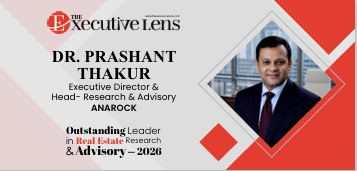
At the centre of this evolving landscape stands Dr. Prashant Thakur, Executive Director & Head – Research & Advisory at ANAROCK, whose work has consistently pushed the industry toward greater discipline, transparency, and strategic clarity. Over the years, his approach has moved real estate research from mere observation to informed direction, positioning it as a critical force in navigating India’s dynamic property market.
Entering a Sector That Shapes Economies
For Dr. Prashant Thakur, the decision to build a career in real estate was never about the industry in its most visible form. It was about the scale of its impact. Real estate, as he saw it early on, sits at the intersection of economic growth, urban development, and societal progress. It influences how cities expand, how capital is deployed, and how aspirations translate into tangible outcomes.
At a time when the sector was still grappling with fragmentation and limited transparency, what stood out was not just its importance, but its potential. There was a clear need for structured thinking, data-backed insights, and a more disciplined approach to understanding market dynamics. Research, in that sense, was not just an analytical exercise. It was a way to bring stability and direction to an industry that was evolving rapidly but unevenly.
Over time, as the sector’s contribution to the economy deepened and its linkages across industries strengthened, the role of research became even more critical. It was no longer sufficient to interpret trends. The need was to anticipate shifts, assess risks, and provide a framework that stakeholders could rely on with confidence.
Dr. Thakur says, “Real estate is not about buildings, it is about nation-building. My journey has reinforced one conviction, research must not merely interpret markets, it must provide stability, foresight and responsible direction in times of both optimism and uncertainty.”
Watching the Industry Transform from Within
Few sectors in India have undergone as fundamental a transformation in such a relatively short span of time. What was once characterised by opacity and fragmented practices has gradually moved towards a more structured and accountable ecosystem.
The introduction of regulatory frameworks brought a much-needed shift in how projects were governed and delivered. Once, inconsistent transparency became a baseline expectation. At the same time, the entry of institutional capital and the rise of investment platforms introduced a new level of financial discipline, aligning the sector more closely with global standards.
The introduction of regulatory frameworks brought a much-needed shift in how projects were governed and delivered. Once, inconsistent transparency became a baseline expectation. At the same time, the entry of institutional capital and the rise of investment platforms introduced a new level of financial discipline, aligning the sector more closely with global standards.
For Dr. Thakur, witnessing this evolution from within offered more than just insight. It reinforced the idea that research must evolve alongside the industry it serves. As real estate moved towards institutionalization and global integration, the expectations from advisory functions also shifted. The focus expanded from data collection to strategic interpretation, and eventually, to enabling informed decision-making at scale.
Leadership Rooted in Systems
At the heart of Dr. Thakur’s leadership philosophy lies a clear and grounded idea: leadership is about stewardship. It is not defined by visibility, but by the ability to build systems that endure beyond individuals.
Rather than centralizing authority, his approach has focused on enabling capability. Strong second-line leadership, well-defined processes, and a culture anchored in accountability form the backbone of his teams. In such an environment, outcomes are not dependent on a single individual but on a collective that is aligned in purpose and execution.
Discipline remains a defining principle. Markets often reward patience and penalize impulsiveness, and leadership, in his view, follows the same pattern. Decisions grounded in structured thinking and intellectual honesty tend to sustain over time, even through volatile cycles.
“You are only as good as your team. Individual success is temporary, but institutional strength is what endures over time,” adds Thakur.
Thinking Through Cycles, Not Moments
Real estate is inherently cyclical, shaped by economic shifts, policy changes, and evolving market sentiment. For Dr. Thakur, navigating these cycles has never been about reacting to immediate movements, but about understanding the structural forces that drive them.
Short-term fluctuations can often distort perspective, but long-term fundamentals tend to remain intact. By focusing on macroeconomic indicators, demographic trends, and capital flows, his approach has consistently emphasized clarity over reaction.
An important dimension of this thinking comes from his interest in behavioral finance. Markets are influenced not just by data, but by human behavior. Sentiment, bias, and collective psychology often shape outcomes in ways that numbers alone cannot fully explain.
This perspective proved particularly valuable during periods of heightened uncertainty, such as the pandemic. While volatility dominated market conversations, the focus remained on structural fundamentals rather than extreme projections. The result was a more balanced and measured interpretation of the situation.
Dr. Thakur, “In uncertain periods, it is not just numbers that guide decisions. Understanding behavior and staying anchored to fundamentals prevents overreaction and helps maintain balance.”
The Expanding Canvas of Real Estate
The scope of real estate today extends far beyond its traditional boundaries. The sector is no longer limited to residential and commercial segments. It now encompasses a diverse range of asset classes that reflect broader economic and technological shifts.
Data centres, logistics parks, life sciences infrastructure, rental housing, and senior living are emerging as significant growth areas. These segments are shaped by digital transformation, changing consumption patterns, and evolving demographic needs, making them integral to the next phase of the industry’s development.
India’s position within the global real estate landscape has also strengthened considerably. In strong years, the country records nearly 50 to 60 million sq. ft. of annual office leasing. It hosts over 1,500 Global Capability Centres across major cities, reinforcing its position as a strategic global operations hub.
As the sector continues to expand, the role of research has transformed alongside it. These shifts have elevated research from data compilation to decision architecture, requiring a more integrated and forward-looking approach.
Influences That Shaped His Thinking
Dr. Thakur’s professional outlook has been shaped by a blend of global influences, personal values, and lived experiences within the market.
Leaders such as Ratan Tata and Warren Buffett have played an important role in shaping his thinking. From one comes the understanding that leadership must balance ambition with purpose and humility. From the other comes the discipline of consistent thinking, patience, and the importance of process over impulse.
Market downturns have also been powerful teachers. They bring clarity, reinforce discipline, and highlight the risks of emotional decision-making. These periods often shape perspective more deeply than phases of growth.
At a more foundational level, his parents have influenced his values of discipline, integrity, and hard work. These principles continue to guide his approach to both leadership and decision-making, reinforcing the importance of credibility built over time.
Success, Responsibility, and What Comes Next
For Dr. Thakur, success is not defined by milestones alone. It is measured by the consistency of contribution, the trust built over time, and the systems created to sustain progress.
Professionally, this translates into the reliability of insights, the strength of institutional frameworks, and the growth of teams that continue to evolve independently. Success, in this sense, is a continuous process rather than a single achievement.
On a personal level, it extends to the values carried forward to the next generation. Discipline, empathy, integrity, and clarity of purpose form the foundation of what he considers meaningful success.
Recognition, including this honor, is seen not as an endpoint but as a responsibility. It reinforces the need to continue building, mentoring, and contributing to the evolution of the sector. Dr. Thakur says, “Success, to me, is contribution with character.”
The Future of Real Estate Research
The next decade is set to redefine how real estate research is conducted and applied. Technological advancements are already transforming traditional approaches, introducing more dynamic and predictive frameworks.
Artificial intelligence and advanced analytics are enabling deeper insights, moving research beyond descriptive reporting toward forward-looking intelligence. Real-time data ecosystems are enhancing the speed and accuracy of decision-making. At the same time, ESG considerations and climate-risk modelling are becoming integral to evaluating long-term asset performance.
These changes are reshaping the role of research within the industry. It is becoming central to capital allocation, risk management, and strategic planning, influencing decisions at multiple levels.
India, with its scale and growth trajectory, is uniquely positioned to contribute to this evolution. The opportunity lies not just in adopting global standards but in setting new benchmarks that reflect the country’s unique dynamics.
Dr. Thakur says, “Research will not merely interpret markets. It will shape them responsibly, ethically, and strategically.”