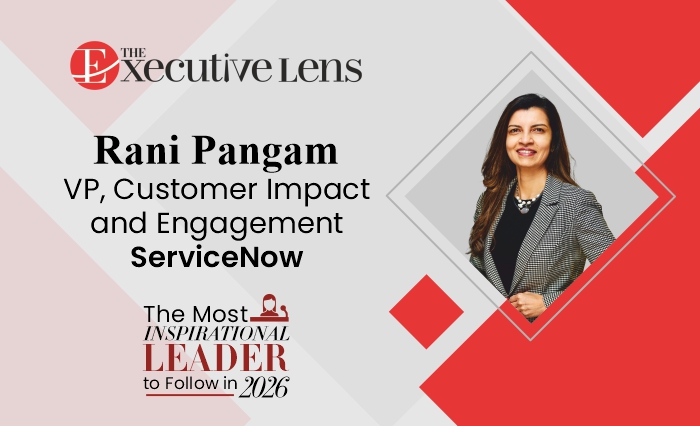
Meet a transformational leader and the woman of the hour, Rani Pangam, VP, Customer Impact at ServiceNow. Rani is a visionary, tech-focused leader who operates at the intersection of precision, scale, impact, and value creation. Her long-standing career spans working with healthcare giants, with an early foundation in consulting, and now serving the enterprise SaaS leader, ServiceNow. As a thought leader in tech, Rani confronts challenges head-on with her rare blend of operational rigour and strategic foresight.
Rani is driven by the responsibility to leave things better than she found them. That desire translates into her work ethic and goals. Whether she is managing a global operating budget or unifying technology platforms, she wants to build products that work for people and provide transparency. She strives to ensure every tech strategy is tied directly to real business goals, so the work they do actually stands the test of time.
Currently, at ServiceNow, Rani leads enterprise-wide digital transformation, aligning Product, Engineering, Finance, HR, IT, Legal, and GTM teams around a unified customer 0 vision. Spearheading highly regulated environments, Rani is well-known for bringing vision into reality; delivering results where execution meets ambition, discipline is non-negotiable, and impact defines success.
Taking the Less-Travelled Route
Rani’s career path definitely hasn’t been linear, but she also thinks that’s been her strength. She started out studying law and finance in her undergrad, which wired her brain to look at risk and structure first. She then pivoted to tech with a Master’s in Information Systems.
In a professional setting, innovative lessons give leaders the opportunity to do something unique and think outside the box. Rani began her career in governance and risk and, over time, continued this unconventional path, leading product, architecture, and Go-to-Market functions. She moved from playing defence in risk consulting to playing offense in AI strategy and operations. This shaped her core philosophy that technology is not a siloed utility, but the central engine for Enterprise-wide value and sustainable growth.
A People-First Leader
Rani has always felt most connected to work when it’s about people, not just technology. As a leader, she understood the assignment when it came to leading a team and managing people. She has led internal digital and AI transformations. The tech part was hard, but the cultural shift was harder. She had to get completely different Executives and their team —Product, Engineering, Finance, Go-To-Market—to share a single vision and march towards a common goal. She shares, “When we started seeing outcomes, everyone aligned with the mission and became part of the revolution. Seeing such a transformation among people was incredibly rewarding. It proved that if you focus on empowering the people, the technical success and business outcomes naturally follow.” She has always worked with a people-first approach, prioritizing the growth and well-being of her team alongside business outcomes.
A Problem-Solving Ninja
One trait that defines successful leaders is not only how they solve their problems, but also how they treat their problems- their first instinct is to embrace their problems and then find feasible solutions. Rani enjoys falling in love with the problem rather than the solution. Whether she is trying to optimize the morning routine for two active kids or tackling a transformation challenge at work, she likes creating order out of chaos. Taking a fragmented, inefficient system and turning it into something that works for people and helps grow the business, is what keeps her energized and coming back to work every day.
Leadership is Not About Leading, But Empowering
Rani’s personal commitment to lifting up other women has completely shaped how she builds teams. She has spent time on the Board of a corporate Women’s Network and mentoring emerging leaders, and it reinforced for her that diverse teams not only build better products and solutions. She was recently reading Unleashed by Frances Frei and Anne Morriss, and they talk about how true leadership isn’t about their own shine, but about focusing relentlessly on empowering others. Whenever she leads a transformation, her primary goal is to make sure the cross-functional teams feel empowered in their work. She truly believes leadership is not about a title or authority but about creating long-term value with people and for people.
Additionally, because Rani’s background consists of different academic focus areas and career trajectories, she has learned that the best ideas rarely come from a single area of expertise. She brings that into her leadership by forcing different teams to talk to each other. Whether they are modernizing legacy code or trying to align sales with internal data, she firmly believes that no single team has all the answers. Since she speaks a bit of “law,” “finance,” “marketing,” and “tech,” she usually acts as the translator between teams to connect the strategic dots and keep teams moving forward.
The Art of Execution: From Stage to Strategy
Rani’s background in classical dance and theatre has influenced how she approaches challenges at work. In any performance, one choreographs incredibly complex moving parts behind the scenes so the audience experiences something completely seamless. When art meets enterprise, a high-impact leadership is cultivated with creative clarity and precision in motion. Bringing that mindset to product rollouts and transformations. When leading internal digital transformations or landing strategic customer opportunities, she uses the empathetic lens of the end customer—just like focusing on a theatre audience. Her aim is to catch friction points early to ensure the highest customer satisfaction.
Balancing Boardroom and Motherhood
When it comes to striking a balance between personal and professional lives, there needs to be a healthy relationship where leadership and life can coexist. Honestly, for Rani, balancing an executive role with raising two young kids means she has to be incredibly intentional with her time. Serving her role, inside and outside the cabin at all times, is not a cakewalk, and hence she doesn’t view personal growth as a luxury; it’s a necessity to stay sharp.
Rani tries to treat her time and energy the way she treats enterprise architecture—one can’t scale a system if the foundation is broken. Early on, working in risk and security taught her that burnout doesn’t help anyone. So, juggling high-stakes digital transformations with family life means she must constantly audit her calendar. She sets clear goals for her teams and says no to a lot of operational noise.
Even while leading large-scale enterprise transformations, Rani makes time to learn and grow. She has recently completed a Chief Operating Officer Certificate and continues to mentor other women in tech careers. Being a mom forces her to be fully present wherever she is. It teaches one quickly how to focus their energy where it actually makes a difference, whether that’s in the boardroom or at the dinner table. Creating harmony between leadership and motherhood while leading with purpose and living with presence is helping Rani thrive at work and at home.
Grounded in Values
Core values set the foundation for successful leadership, and for Rani, it comes down to foresight, integrity, and empathy. At work, that means advising the executives with honesty—not just chasing the latest tech trend, but building secure, reliable solutions that will create lasting value. Those same values guide her at home. Raising two young children requires a lot of looking ahead, staying true to the word, and having the empathy to guide them through hard moments. In both parts of her life, she just wants to create environments where people feel secure, supported, and capable of doing their best.
Tech: The Driving Force of Influence
The key influence on Rani’s career has honestly been watching the tech industry completely reinvent itself. When she started, tech was mostly a defensive, back-office utility. Now, it’s the main driver of revenue. Navigating that shift changed how she thinks as a leader. Right now, she is really influenced by the conversations around AI, no different than every leader in the world today. David De Cremer makes a great point in his book, The AI-Savvy Leader—he argues that business leaders can’t just hand AI over to the technical teams; we must actively bridge the gap.
Defining Success
Rani fondly states, “Professionally, success has to be a mix of hard business results—like speeding up release cycles or growing revenue or cutting costs—and the strength of the teams I build. Hitting the numbers feels hollow if the culture is broken. Personally, I apply the same success factors. It’s not just seeing your family’s success in quantitative measures but also seeing the curiosity and joy in my kids, having a strong partnership with my husband, and making sure I’m still learning and adapting as life changes.”